
Amazon disclosure: As an Amazon Associate I earn from qualifying purchases.
Affiliate disclosure: Health Picks PRO may earn a commission if you buy through links on this page, at no extra cost to you. This does not change our conclusions. This article is research-based: we did not personally test these products. It is general information, not medical advice. Read our full disclosure.
Last updated: October 16, 2026 · Research-based guide · Not medical advice
Until 2022, buying a hearing aid in the U.S. almost always meant a hearing exam, a prescription or fitting from a licensed professional, and a bill that could run into thousands of dollars. Then the FDA created a new category: over-the-counter (OTC) hearing aids, sold online and in stores without a prescription.
Now there are two paths. Which one is right for you depends mainly on how much hearing loss you have, your budget, and how much professional support you want. This guide explains the differences in plain English, with FDA guidance, so you can choose with confidence.
How we researched this: this is a research-based guide built from FDA and NIDCD information and manufacturer specifications. We do not test devices hands-on, and we can’t diagnose hearing loss. Only a hearing professional can do that.
Medical disclaimer: This article is general information, not medical advice. See a doctor or hearing professional if you have sudden or one-sided hearing loss, ear pain or drainage, dizziness, or ringing in one ear. Read our medical disclaimer.
The short answer
- Choose OTC if you’re 18 or older, think your hearing loss is mild to moderate, and have none of the FDA’s red-flag symptoms.
- Choose prescription if your loss seems severe, you’re under 18, you have red-flag symptoms, or OTC aids haven’t helped enough.
- Not sure? Get a hearing check first. It’s the cheapest way to avoid buying the wrong device.

What the FDA OTC rule changed
The FDA’s final rule on OTC hearing aids took effect on October 17, 2022. It lets adults with perceived mild to moderate hearing loss buy hearing aids directly, with no medical exam, prescription or audiologist fitting required (FDA). OTC devices must meet FDA requirements for safety, maximum sound output and labeling. That includes clearly saying “OTC” and “hearing aid” on the box.
Prescription hearing aids still exist, and they serve everyone OTC aids don’t: people with severe or profound loss, children and teens, and anyone whose hearing needs professional fitting and follow-up.
OTC vs. prescription: side-by-side
| OTC hearing aids | Prescription hearing aids | |
|---|---|---|
| Who they’re for | Adults 18+ with perceived mild to moderate loss | Any age, any degree of loss |
| Exam needed? | No (but recommended) | Yes, by an audiologist or hearing aid specialist |
| Fitting | Preset, or self-fitting via app | Programmed by a professional to your audiogram |
| Where to buy | Online, pharmacies, retailers | Hearing clinics, audiologists, some big-box clinics |
| Typical cost | Generally lower | Often much higher, with fitting and services bundled |
| Follow-up care | Brand support; varies | Adjustments and check-ups usually included |
| Max output | Limited by FDA rule | Can be fitted for severe/profound loss |
Hearing aid prices range from hundreds to several thousand dollars, according to the NIDCD. Check retailers for current OTC prices.
Swipe the table sideways on mobile to see all columns.
When OTC hearing aids make sense
The FDA lists common signs of mild to moderate hearing loss. You may be a good OTC candidate if:
- You have trouble hearing speech in noisy places
- You find it hard to follow speech in groups
- You have trouble hearing on the phone
- You turn up the TV or radio and others complain it’s too loud
By contrast, the FDA says that if you can’t hear speech even in a quiet room, or don’t hear loud sounds well, your loss may be more than mild to moderate.
OTC aids come in two broad types. Basic preset aids, like the Audien Atom Pro 2, offer volume control and a few modes. Self-fitting aids, like the Sennheiser All-Day Clear and Jabra Enhance Select M2, use an app-based hearing check to tailor the sound. Their makers describe them as FDA-cleared.
Check Atom Pro 2 price on Amazon
For a full comparison, see our Best OTC Hearing Aids on Amazon (2026) roundup.
Advantages of OTC
- Lower upfront cost and no appointments
- Buy today and try them at home
- Self-fitting models let you fine-tune the sound yourself
- A low-pressure first step for people who’ve been putting off help
Limitations of OTC
- Not designed for severe or profound loss
- Fitting relies on presets or your own judgement
- Less hands-on support when something doesn’t sound right
- No professional check for medical causes, such as earwax or infection
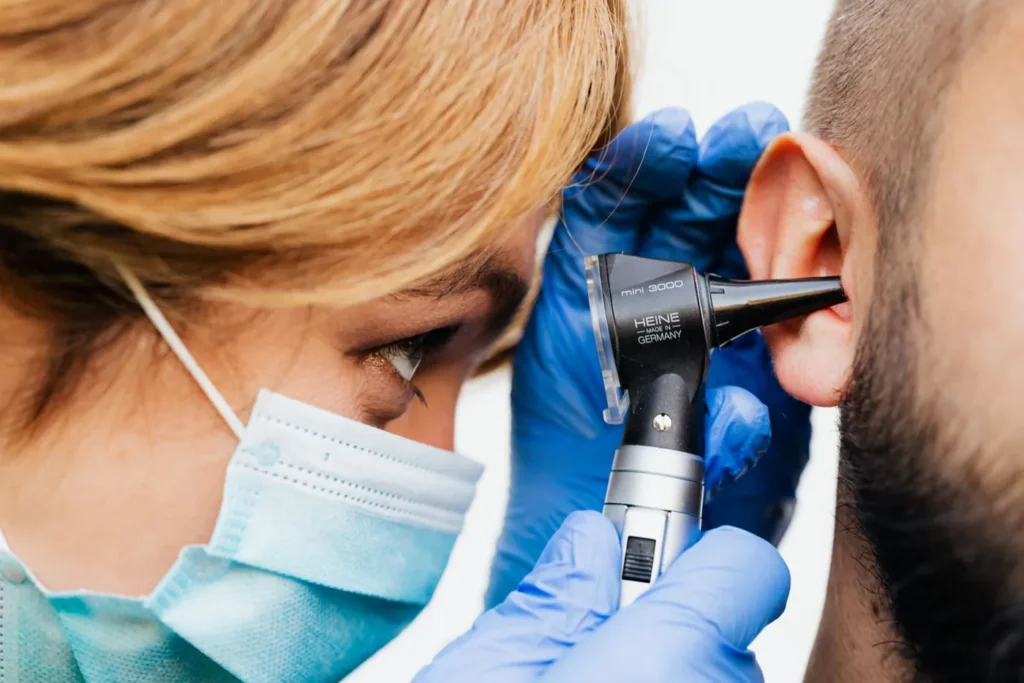
When you need prescription hearing aids, or a doctor
The FDA says to see a doctor, preferably an ENT specialist, before buying OTC aids if you have any of these (FDA):
- Sudden hearing loss, or a change in hearing within the past six months
- Hearing loss or ringing (tinnitus) in only one ear
- Ear pain or discomfort
- Fluid, pus or blood coming from the ear
- Dizziness or vertigo
- A history of excessive earwax, or a feeling that something is in your ear
- An ear that looks deformed, from birth or injury
Sudden hearing loss can be a medical emergency, so seek care promptly.
Signs that your loss may be beyond moderate include difficulty hearing even loud speech, trouble following conversation in quiet rooms, or being unable to hear loud sounds like traffic. In these cases, prescription aids programmed to your audiogram are usually the right choice.
Advantages of prescription
- Professional diagnosis that can catch medical problems
- Precise programming to your hearing test results
- Fitting for every degree of loss, including severe and profound
- Ongoing adjustments, cleaning and follow-up care
Limitations of prescription
- Often much more expensive
- Several appointments needed
- Insurance coverage is inconsistent. The NIDCD notes that Medicare does not cover hearing aids for adults.
Cost: what to expect
According to the NIDCD, hearing aids range from hundreds to several thousand dollars, depending on style and features. OTC models generally sit at the lower end. Budget OTC models start around the low hundreds, while premium self-fitting models cost more but are still often below typical prescription pricing. Prescription prices often include the exam, fitting and follow-up visits.
Because prices change often, we don’t quote live prices. Check Amazon for current prices on our picks:
| Model | Type | App | Good if you want… | Price tier |
|---|---|---|---|---|
| Audien Atom One | Basic preset | No | Lowest-cost trial | Budget |
| Audien Atom Pro 2 | Basic preset | No | No-app use with noise modes | Lower mid |
| ELEHEAR Beyond | App-adjustable | Yes | Streaming and tinnitus sounds | Mid |
| Sennheiser All-Day Clear | Self-fitting | Yes (setup) | Personalized fit, big brand | Premium |
| Jabra Enhance Select M2 | Self-fitting | Yes | Auracast and a personalized fit | Premium |
Price tiers are relative, based on Amazon listings on October 16, 2026.
Swipe the table sideways on mobile to see all columns.
Check Sennheiser All-Day Clear price on Amazon
A simple decision path
- Check for red flags. If any FDA warning signs apply, see a doctor first.
- Get a baseline hearing check. An online hearing visit or test can show whether your loss is likely mild to moderate.
- If it’s mild to moderate, try OTC. Pick basic preset aids for simplicity, or self-fitting aids for personalization.
- Give it a few weeks within the return window.
- If you’re still struggling, see an audiologist about prescription aids. Your OTC experience still helps you know what you need.
Not sure how much hearing loss you have? Read our online hearing test guide or book an online hearing visit with Sesame Care.

Can you switch later?
Yes. Many people start with OTC aids and move to prescription aids if their hearing changes or they need more help. Some audiologists will also help with OTC devices for a fee. Hearing often changes gradually with age, so it’s sensible to recheck it every year or two.
Looking for picks for an older relative? See our best OTC hearing aids for seniors guide. On a budget? Read our cheap OTC hearing aids guide.
Frequently asked questions
Is an OTC hearing aid as good as a prescription hearing aid?
For adults with mild to moderate loss, OTC aids can help a lot, and some are FDA-cleared self-fitting devices. Prescription aids are programmed by a professional to your hearing test and suit every degree of loss, so they are usually better for more complex or severe hearing loss.
Do I need a hearing test to buy OTC hearing aids?
No. The FDA rule does not require an exam or prescription for adults 18 and older. A hearing check is still a good idea to confirm your loss is in the mild-to-moderate range.
Can children use OTC hearing aids?
No. OTC hearing aids are only for adults 18 and older. Children and teens need prescription hearing aids and professional care.
Does insurance cover OTC or prescription hearing aids?
Coverage varies. The NIDCD notes that Medicare does not cover hearing aids for adults, though some Medicare Advantage and private plans offer benefits. Many people can use FSA or HSA funds.
What happens if OTC hearing aids don’t help enough?
Return them within the return window if possible, and see an audiologist. You may need prescription aids, or there may be a medical cause, such as earwax or an ear condition, that needs treatment.
Sources
- FDA: OTC Hearing Aids, What You Should Know
- NIDCD: Hearing Aids
- Manufacturer product pages: Audien, ELEHEAR, Sennheiser, Jabra Enhance (accessed October 2026)