
Affiliate disclosure: Health Picks PRO may earn a commission if you buy through links on this page, at no extra cost to you. This does not change our conclusions. This article is research-based: we did not personally test these products. It is general information, not medical advice. Read our full disclosure.
Last updated: October 2026 · Research-based guide · Not medical advice
Before you buy any hearing aid, it helps to know roughly how much hearing loss you have and whether an over-the-counter option is even appropriate. The good news is that you don’t always need a long wait or a large bill to find out. This guide explains the types of online hearing checks, what they can and can’t tell you, and how a telehealth marketplace like Sesame Care can help you see a licensed clinician quickly at an upfront price.
This is a research-based guide drawn from FDA guidance and Sesame’s own published information. We have not received care through Sesame for this article.
Why get your hearing checked before buying OTC hearing aids?
The FDA’s OTC hearing aid category, in effect since October 17, 2022, lets adults 18+ with perceived mild to moderate hearing loss buy hearing aids without a prescription or exam (FDA). The key word is perceived. You judge for yourself whether your loss is mild to moderate. A check can confirm that judgment and catch problems an OTC device can’t fix, such as earwax blockage, infection, or sudden hearing loss.
The FDA lists common signs of mild to moderate hearing loss:
- Trouble hearing speech in noisy places
- Difficulty following speech in groups
- Trouble hearing on the phone
- Listening makes you tired
- Needing the TV or radio louder than others like
It also lists signs that point to needing a professional: being unable to hear speech even in a quiet room, or not hearing loud sounds well.
Red flags: see a doctor first
According to the FDA, you should see a doctor, preferably an ear-nose-throat specialist (ENT), before using an OTC hearing aid if:
- Your hearing changed suddenly in the past six months
- Your hearing gets worse and then better again
- One ear hears worse than the other, or you hear ringing or buzzing in only one ear
- You have ear pain or discomfort, or have seen blood, pus or fluid from your ear in the past six months
- You have a lot of earwax or think something is in your ear
- You have dizziness or vertigo
- Your ear has an unusual shape from birth or injury
Sudden hearing loss can be a medical emergency. If it happens, seek care promptly. Do not wait for an online screening.
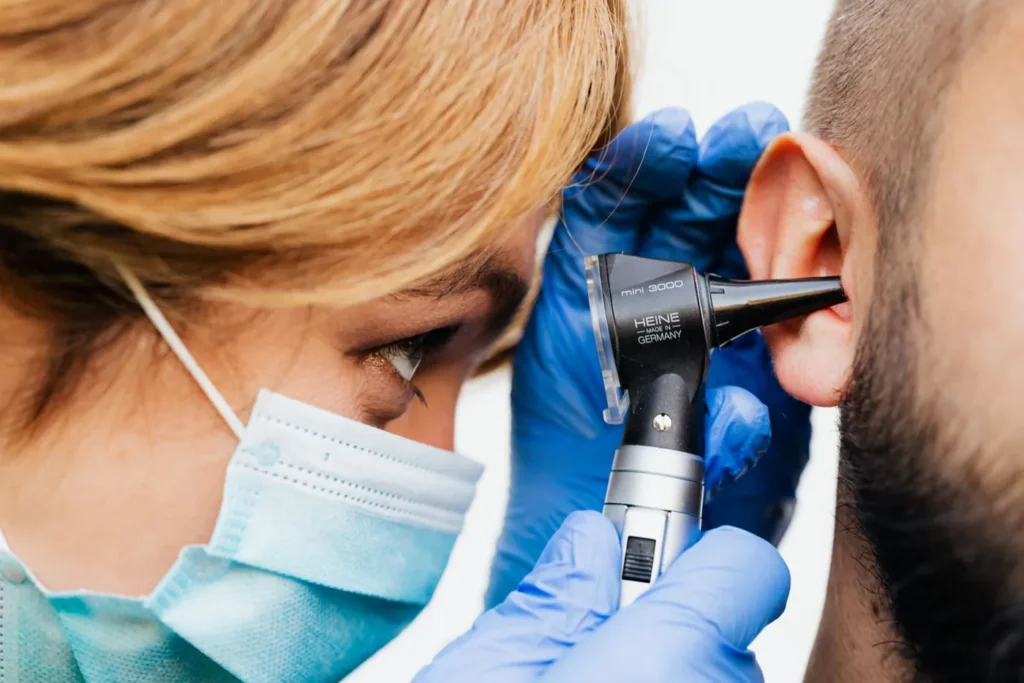
Types of online hearing checks
1. Free self-screening tools
Many hearing aid brands and some apps offer quick online tone or speech-in-noise screenings. They are convenient and free, but your results depend on your headphones, room noise, and device volume. They are screenings, not diagnoses. They also can’t look inside your ear to check for wax or infection.
2. Self-fitting hearing aid tests
The FDA notes that some OTC hearing aids are “self-fitting” and include built-in hearing tests or apps that tune the device to you. These tests are designed for setting up the device, not for diagnosing medical conditions.
3. Telehealth consultation with a clinician
A video visit with a licensed provider lets you describe your symptoms, review your history, and get advice on whether an OTC hearing aid is reasonable or whether you need an in-person exam, such as audiometry with an audiologist or an ENT visit. The clinician can also tell you if your symptoms match any red flags. This is where Sesame Care fits in.
4. In-person audiology exam
A full diagnostic hearing test in a sound booth is still the gold standard. It’s the best choice if you have red flags, more than moderate loss, or want prescription hearing aids.
What is Sesame Care?
Sesame is an online healthcare marketplace where you book telehealth and in-person appointments directly with licensed providers at upfront cash prices. According to Sesame:
- You see the price before you book, with no hidden fees. Sesame’s telehealth page advertises visits “as low as $34” (prices vary by provider and service).
- No insurance is needed. Sesame says it does not bill health insurance.
- Same-day appointments are often available, and visits work on desktop, tablet or smartphone.
- Visits through its app include messaging with your clinician before or after the appointment.
- For hearing specifically, Sesame has said that SesamePlus members can access free Audicus virtual hearing tests nationwide, plus discounted in-person hearing consultations and evaluations in New York. Check current availability, because offers change.
Sesame also lists audiologists among its providers. It notes that audiologists perform hearing tests to help determine the cause and degree of hearing loss, and that some appointments require in-person care.
Browse hearing-related telehealth visits on Sesame

How to book a hearing-related visit on Sesame
- Go to Sesame and search for a relevant service, such as “hearing,” “audiologist,” “ear,” or a general telehealth visit.
- Compare providers by reviews, price and available time slots.
- Pay the upfront price online.
- Complete the brief medical history form.
- Join the video visit at your scheduled time. Have your symptom list and questions ready.
Questions to ask during your visit
- Do my symptoms match mild to moderate hearing loss?
- Is there any sign of a red-flag condition?
- Could earwax or an ear infection be causing this?
- Is an OTC hearing aid reasonable for me, or should I see an audiologist or ENT in person?
- If I try an OTC aid, what should I watch for?
What a telehealth visit can’t do
A video visit can’t physically examine your ear canal or run a calibrated booth test. If your clinician thinks you need those, they will refer you to in-person care. Online screenings are also no substitute for a diagnosis when symptoms are sudden, one-sided, or painful.
After your check: next steps
- Mild to moderate, no red flags: an OTC hearing aid may be worth trying. See our Audien Atom Pro 2 review and comparison guide.
- Red flags or more severe loss: follow your clinician’s referral for an in-person exam.
- Considering supplements: read our Whispeara review first. Supplements do not amplify sound.
FAQ
Are online hearing tests accurate?
They can be a useful first look, but accuracy depends on your equipment and environment. They screen for problems; they don’t diagnose. A clinician can help you interpret the results.
How much does a Sesame visit cost?
Prices are set by providers and shown before booking. Sesame advertises telehealth visits starting around $34. Prescription costs, if any, are separate.
Do I need insurance?
No. Sesame says it is available to everyone regardless of insurance status.
Do I need a test to buy an OTC hearing aid?
Legally, no — adults with perceived mild to moderate loss can buy one directly. A check is still a smart, low-cost step, especially if you’re unsure.
Bottom line
A quick hearing check, whether through a free screening or a low-cost telehealth visit, can save you money and catch problems an OTC hearing aid can’t fix. Sesame Care makes it simple to see a licensed provider at an upfront price, often the same day.
Find a telehealth provider on Sesame
Sources
- U.S. FDA – OTC Hearing Aids: What You Should Know: fda.gov
- Sesame – Telehealth visits: sesamecare.com/service/telehealth-visit
- Sesame – Mobile app: sesamecare.com/join/mobile-app
- Sesame – Better Hearing and Speech Month: sesamecare.com/blog
- Sesame – Audiologist information: sesamecare.com